AI in a UK Private Practice: Where It Helps, and Where It Should Not Be
A sceptical, practical look at AI in private healthcare admin — note drafting, summarising, scheduling and intake — and the clear lines it should not cross, including consent, record accuracy and clinical decisions.
Start from the admin, not the diagnosis
Most of the genuine, available value of AI in a private practice today is in reducing typing and coordination, not in clinical reasoning. That is an unglamorous claim, and it is the honest one. A clinician who finishes their notes during the appointment instead of at nine in the evening has gained something real and low-risk. A tool that offers a diagnosis carries an entirely different risk profile and a different set of obligations.
If you are evaluating AI for a practice, the useful sorting question is: does this write something a human then checks, or does it decide something?
Where it genuinely helps
Drafting the consultation note. Producing a structured first draft from the consultation, which the clinician then reads, corrects and signs. The clinician remains the author. The saving is real and it is mostly a typing saving.
Summarising before an appointment. Condensing a long record — previous letters, results, medication changes — into a briefing so the clinician arrives at the appointment already oriented. Useful precisely in proportion to how messy the record is.
Structuring what the patient sends in advance. Turning free-text intake into something organised, so the appointment starts further along.
Drafting routine correspondence. A first draft of a GP letter or a results explanation, for review before it goes anywhere.
Diary work. Suggesting how to fill a gap left by a cancellation, or flagging a pattern of non-attendance worth looking at.
Note what these have in common: a human reads the output before it counts for anything.
The lines that should not be crossed
Nothing enters the clinical record unreviewed. A drafted note is a draft until a clinician reads it and signs it. Any workflow where AI-generated text reaches the record without a human having actually read it — as opposed to having clicked past it — is a bad workflow, regardless of how good the model is.
No clinical decision. Triage, diagnosis, prescribing, deciding urgency. The responsibility sits with the clinician and cannot be delegated to a tool.
No unconsented recording of patients. If a tool listens to a consultation, patients need to know and to be able to decline, and declining must not degrade their care. Silent recording is not an option.
No silent training on patient data. Know whether your patients' data is used to train anyone's model, where it is processed, and who can access it. Get the answer in writing from the vendor.
No unreviewed patient-facing output. Anything sent to a patient in the practice's name should have been read by a person.
REVIEW: Using AI on identifiable patient data engages UK GDPR obligations — lawful basis, transparency, data-processing arrangements with the vendor, and potentially a data protection impact assessment. Consent and confidentiality for recording consultations also engage professional standards. Get both a data-protection and a professional-standards review before deploying anything on real patient data. This article is not legal advice, and this is exactly the kind of decision it would be unwise to take from an article.
Questions to put to a vendor
- Where is patient data processed and stored, and is any of it outside the UK?
- Is our data used to train your models, in any form? Get this in writing.
- What happens to a recording after the note is drafted, and can we set retention?
- What does the clinician review step actually look like — can it be skipped?
- What happens when the model gets it wrong, and how would we know?
- Can we turn individual features off?
- What are your terms if we leave — can we export everything?
Judging whether it worked
Not by whether it feels futuristic. By whether documentation time per clinic fell, whether the notes are as good or better after clinician correction, whether clinicians actually keep using it after the novelty passes, and whether any patient has complained. Give it a defined trial period with someone accountable for calling it, including calling it a failure.
How Roshtah fits
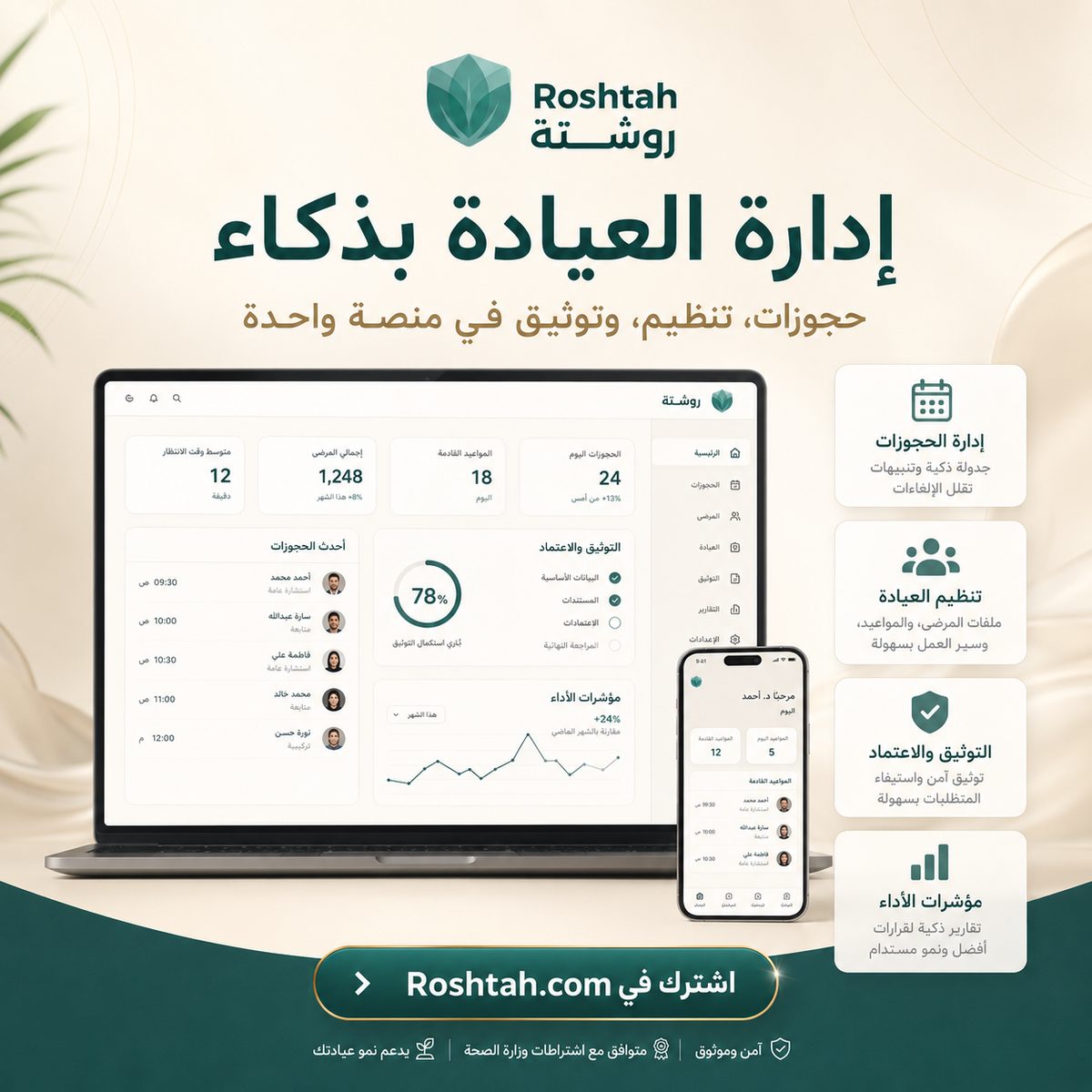
Roshtah's AI features sit on the admin side by design: drafting notes the clinician reviews and edits before anything is saved, summarising a record before an appointment, structuring pre-appointment intake, and organising the diary. They do not triage, diagnose or prescribe, and they can be turned off per practice. The clinical decision is the clinician's, always.
Roshtah multi-doctor clinic tour — branches, shifts and per-doctor pricing

Try Roshtah today
Doctors, clinics, appointment booking and online medical consultations in Syria — all in one place.